

Many organizations are busy. Far fewer are making consistent progress.
Across industries, I work with leadership teams that are committed, capable, and genuinely invested in their organization’s success. Meetings are full, initiatives are active, and people are working hard. And still, results feel uneven, priorities compete, accountability blurs, and execution depends too heavily on a few individuals holding everything together.
Operating discipline is what separates organizations that stay busy from those that build consistent momentum — and most leaders underestimate how much that distinction shapes everything downstream.
When Execution Starts to Fray
As organizations grow, evolve, or take on greater complexity, the systems that once supported execution often fall behind. Informal decision-making gives way to confusion. Ownership becomes assumed rather than clear. Leaders compensate by doing more, carrying more, and stepping in more frequently.
In mission-driven environments, this pattern is especially common. Leaders care deeply about outcomes, people, and impact. When pressure rises, they respond by accelerating activity. Over time, motion replaces momentum.
Activity feels productive. Traction produces results.
The difference between the two is not urgency. It is discipline.
Why Traction Resonates with Leaders
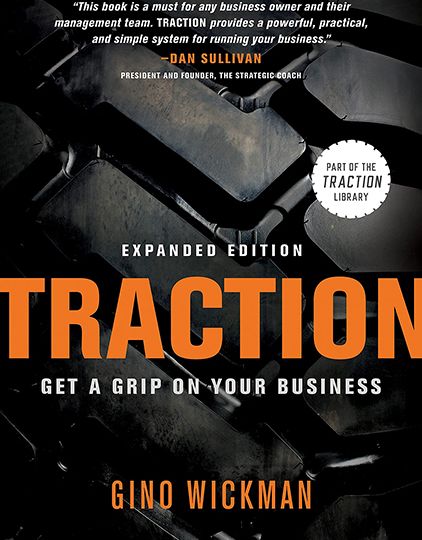
This is why the ideas in Traction continue to resonate with leaders across sectors. At its core, the book speaks to a frustration many organizations experience but struggle to name: vision without disciplined execution creates exhaustion, not progress.
Traction works best in organizations that are large enough to require coordination but small enough to feel the strain when systems break down. While it is often associated with entrepreneurial companies, its strongest impact tends to appear in organizations with roughly 10 to 250 employees—where complexity has outpaced structure and leadership still has direct influence on how work gets done.
What matters more than size, however, is readiness. Traction works when leaders are willing to be explicit about priorities, honest about accountability, and consistent in how decisions are made and reviewed.
What Traction Looks Like When It’s Done Well
When operating discipline takes hold, organizations experience tangible shifts. Priorities become clearer and fewer. Decision-making speeds up because ownership is no longer ambiguous. Leadership teams stop revisiting the same unresolved issues. Progress becomes visible, not just reported.
Perhaps most importantly, execution no longer depends on heroic effort. Responsibility moves from individuals to systems. Leaders regain capacity to think, lead, and steward the organization rather than constantly manage around breakdowns.
These outcomes do not emerge because a framework was adopted. They emerge because leaders changed how they operate together.
The Commitment Most Leaders Underestimate
One of the most common missteps I see is assuming Traction is a tool that can be installed rather than a discipline that must be practiced. Frameworks do not create traction on their own. Leadership does.
Traction requires alignment before action. It requires leaders to name real issues rather than manage around them. It requires discipline in meetings, follow-through on commitments, and tolerance for short-term discomfort while new habits take hold.
Organizations that approach Traction as a checklist struggle. Organizations that treat it as a leadership practice build momentum that lasts.
Why It Works in Healthcare and Community-Based Organizations
Healthcare organizations, particularly critical access hospitals, rural systems, and community-based organizations, operate with limited margin for error. Resources are constrained. Stakes are high. The instinct to do more is understandable.
Traction works well in these environments because it reduces noise, protects limited capacity, and creates predictable rhythms for execution. When adapted thoughtfully, it helps leaders focus on impact rather than activity without losing sight of mission or people.
The framework succeeds not because healthcare is different, but because clarity and discipline matter more when complexity is unavoidable.
From Framework to Practice
The real work begins after the language is introduced.
Moving from activity to traction requires leaders to translate concepts into daily practice. It means deciding what truly matters, clarifying who owns what, and establishing rhythms that support follow-through. It means modeling the discipline the organization is being asked to adopt.
This is where leadership coaching, leadership development, and strategic consulting intersect. Traction holds when it becomes embedded in how leaders think, decide, and lead together.
A Leadership Reflection
If your organization feels active but not aligned, busy but not advancing, the issue may not be effort. It may be the absence of discipline around how work gets done.
Traction is not about speed.
It is about consistency.
And consistency is a leadership choice.
Source:
EOS Worldwide – Ideal Client Profile
https://www.eosworldwide.com/what-is-eos
How TISOMO Partners with Organizations
TISOMO Consulting Group partners with organizations across industries to move from talking about traction to implementing it. Through leadership coaching, leadership development, and strategic HR consulting, we work alongside leaders to translate operating frameworks into sustainable practice—so clarity, accountability, and execution hold over time.
To explore how TISOMO can support your organization’s journey from activity to traction, contact TISOMO Consulting Group.